A 2025 systematic review published in the European Journal of Physiotherapy reported that pain neuroscience education may reduce chronic neck pain compared with other therapies. Based on seven randomized-controlled trials with a total of 11 interventions and 422 people, the researchers found pain education groups “showed effectiveness” for kinesiophobia, fear and avoidance beliefs, pain catastrophization, anxiety, disability, self-efficacy, and various psychosocial factors.
However, several systematic reviews have found small to medium—yet mixed—effects of pain education for various types of pain. For example, a 2023 systematic review found that pain education tends to improve psychosocial factors, pain, disability, and catastrophization when it is paired with other treatments, primarily exercise, rather than used on its own. Led by Dr. Ferran Cuenca-Martínez from the University of Valencia, the researchers reported that pain education alone “did not show statistically significant improvements” in the symptoms mentioned above.
The study reviewed 16 systematic reviews that covered patients with chronic low back or neck pain, osteoarthritis, rheumatoid arthritis, and fibromyalgia. The interventions compared included groups on a waiting list, minimal interventions (e.g. relaxation, breathing, or general educational advice), no intervention, or manual therapy.
“It seems therefore that the main strength of the [pain education] is the interaction with other interventions to enhance its effectiveness with respect to the outcomes assessed,” Cuenca-Martínez et al. wrote. They added that the studies’ quality were ranked “critically low” and showed substantial overlap, which limits confidence in the findings.
Another issue they found was a “great variability” in the results, which depended on the variables, such as the pain education content, format, the population studied, and interventions added to the session. Cuenca-Martínez et al. cited a 2023 meta-analysis that found a “linear association” between how long a pain education session lasts and the degree of anxiety reduction.
While the mechanisms behind pain education are not fully understood, Cuenca-Martínez et al. wrote that it may help patients feel heard, improve understanding of their condition, support better coping, and reduce threat perception within the nervous system.
“Future studies should determine not only whether [pain education] is effective, but also in which patients it is effective and in what way it is best to apply it,” they wrote.
Pain education in context
Despite the small to medium benefits of pain education for chronic pain, an international team of researchers led by Moseley wrote in the Journal of Pain in 2024 that an audit of the pain education literature showed two “important patterns” that should be taken into context.
“First, when the learning objectives of [pain education] are achieved, patients tend to gain excellent and sometimes transformative pain and disability-related outcomes,” they wrote. “Second, the learning objectives of [pain education] are achieved in about 50% of the patients. Critical here is the clear evidence that pain and disability did not improve in those patients who did not undergo conceptual change. This finding is corroborated by a qualitative appraisal of patient responses to pain education.”
The researchers also admitted that pain researchers and clinicians generally “have not been doing very well at instilling deep learning” to patients, which includes delivery and improving content. “If we can do better, better clinical outcomes should follow,” they wrote.
Other research on pain education found:
- Based on 17 studies with 1,078 patients total, a 2024 systematic review and meta-analysis found pain education combined with exercise or physiotherapy can better reduce short-term chronic low back pain and disability than exercise or physiotherapy alone.
- A 2025 systematic review found pain education has a “ positive effect on pain management in patients with chronic pain. Moreover, the effects on disability appear to be more enduring over time compared to the effects on pain intensity.” This is based on 19 studies with 693 patients total.
- A 2023 systematic review of eight systematic reviews and 30 meta-analyses found that pain education’s methodologies to be “critically low.” “It is impossible to make clear clinical recommendations for delivering pain neuroscience education based on current meta-analyses,” the researchers wrote.
- For fibromyalgia, pain education may decrease pain intensity in the post-intervention period, but it “showed no effect on anxiety and pain catastrophizing,” the researchers wrote.
What is pain education and what it isn’t
Moseley and Butler wrote that pain education—or “explaining pain” as they called it— is an educational approach designed to change how people understand the nature and biology of pain. It is both a treatment framework and an educational method, but not a fixed set of techniques or “simply learning new information. Explaining pain draws on conceptual change theory, educational psychology, health psychology, and neuroimmune science.
They wrote that explaining pain teaches that pain can increase with credible cues of danger and decrease with credible cues of safety. Patients explore key ideas, such as:
- The loose relationship between nociception and pain
- The “potent influence” on pain context
- Changes in the nociceptive system as pain persists
- Multiple protective systems that can influence pain
- The adaptability and trainability of biological systems, which can be slow
Pain education can be one-on-one, small groups, or large conference-style sessions lasting up to three hours. “The core objective is to explain to the learner the key biological concepts that underpin pain, with a proficiency and effect such that learners acquire a functional pain literacy,” Moseley and Butler wrote. “That is, they understand how their pain is produced (at least to the extent that science currently allows) and they are able to integrate this new understanding into their wider pain and function-related beliefs, attitudes, behaviors, treatment, and lifestyle choices.”
Overall, explaining pain is:
- A conceptual change approach focused on replacing outdated beliefs about pain with a modern, science-based understanding.
- An educational framework and treatment philosophy, not a rigid technique.
- A method to reconceptualize pain from a sign of tissue damage to a reflection of perceived threat and protection.
- An explanation of pain as an emergent, context-dependent process, not a simple linear signal from tissues to the spinal cord and brain.
- A tool for helping patients understand the adaptability of their biology, including concepts, such as neuroplasticity.
What explaining pain is not:
- Not cognitve behaviorial therapy (CBT) and is not interchangeable with CBT strategies.
- Not advice to “move despite pain.”
- Does not throw out biology and biomedical models to focus only on the psychosocial
- Not general coping advice about managing daily demands with pain.
- Not gate control theory education.
- Not the message that pain has “moved to the brain” or that it is a fixed neurological disease.
- Not a claim that chronic pain is “not real” or “all in your head.”
- Not an assertion that nociception equals pain.
- Not limited to a single delivery method or branded variant
How and why pain education started
According to their 2015 editorial in the Journal of Pain, pain education is founded on the biopsychosocial model that recognizes psychological, social, and environmental factors that mediates the pain experience. This is congruent with the gate control theory and neuromatrix theory of pain that include these factors to explain why someone might be in pain. This led to the rise of including various types of CBT to standard pain treatment.
According to Moseley and Butler, CBT approaches for chronic pain share a theoretical assumption that thoughts, beliefs, and behaviors interact with environmental events, and symptoms—including pain—are shaped by these cognitive processes. Because beliefs influence how pain is experienced, CBT proposes that modifying unhelpful thoughts about pain can improve symptoms. This aligns with the biopsychosocial model, which emphasizes that pain is not purely biological but shaped by meaning, interpretation, and context.
In 2024, the same group of international researchers highlighted the PETAL (Pain Education Team to Advance Learning) Collaboration that continues to use the term “pain science education” instead of “explaining pain” or “pain neuroscience education.” While these terms are similar, the differences are:
- Pain neuroscience education (PNE) focuses on the neurophysiology of pain and was developed and refined by a single researcher/clinician with lived experience of chronic pain recovery.Pain science education (PSE) draws from contemporary content from several pain-related biological sciences.
- PNE is grounded in health sciences while PSE integrates with educational sciences.
- PNE has no formal learning theory applied and has a one-way communication method, such as the practitioner delivers the message and the patient receives.PSE uses the ICAP framework (Interactive, Constructive, Active, Passive) where patients move away from passive behaviors (like listening) to active behaviors (such as applying what they learn). This transitions to constructivism or generating new ideas, and finally to interactive behaviors which involves a dialogue between patients with clinicians or with other patients.
Full details can be found in their paper.
Massage and pain education
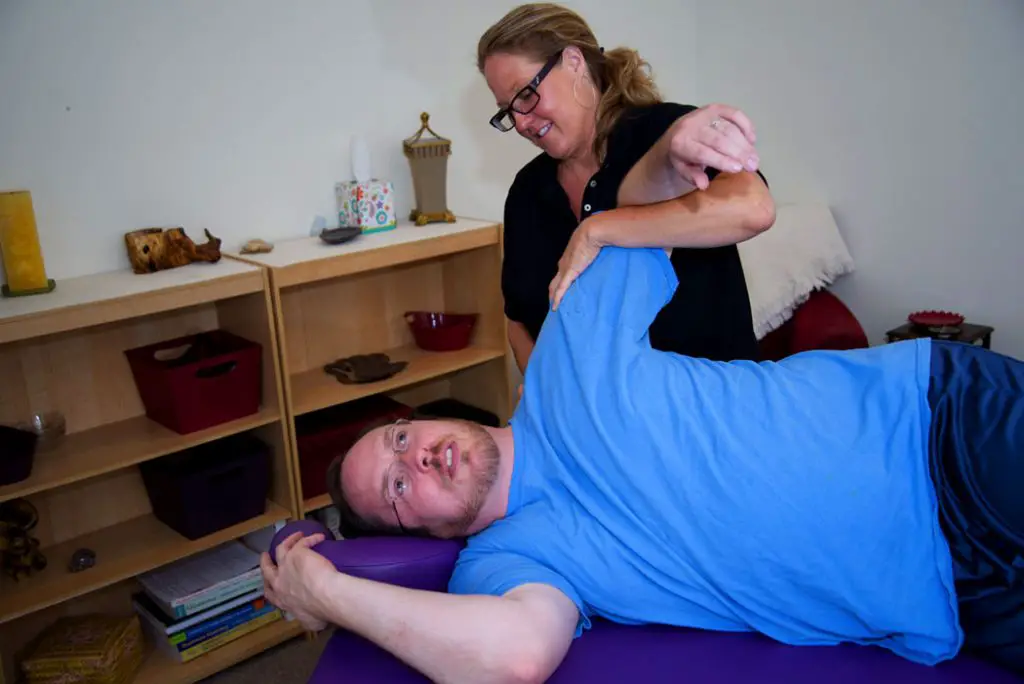
While there are no studies that examine pain education and massage therapy outcomes, existing studies with physiotherapists and other health care professionals could be applied.
“All healthcare providers can learn pain neuroscience and share that with their patient,” Dr. Adriaan Louw told Massage & Fitness, physiotherapist and author of Why Do I Hurt. “Pain neuroscience education’s key tenant is to take the complex pain material and get it on a level that [patients] get it. You do have to, however, be ‘smarter than their patient’ so [therapists] need to study, learn, and know the material well. Remember, a little knowledge can be dangerous. We are now studying all kinds of parameters on ‘learning about pain’ and spreading it to parents, caregivers, kids, the elderly, etc.”
In one of Louw’s early research on pain education, he and his colleagues reported that while the pain education group had lower pain scores than the non-educated group during multiple follow-ups, both groups scored almost the same after a year post-op. However, the cost of tests, treatments, and follow-ups in the pain education group is about 45% less—about $2,600 on average in savings per patient—than the non-educated group.
Culture and pain education
Some researchers emphasize that pain education should also be culturally sensitive because different cultures have different beliefs about pain and responses to it.
For example, a team of researchers from Nigeria, Belgium, and Turkey reported that pain education materials published in Australia, Europe and the U.S. “contain pictures, examples and metaphors that may not be appropriate for the Hausa population” due to “differences in culture, religion, educational levels, or technological advancements.”
They added that pain education materials developed for first-generation Turkish-immigrants living in Belgium “is the only one nearest to Hausa culture due to overlap in religion (Islam), and to some extent with regard to clothing and gender roles.” They reported that mainstream pain education materials used a lot of pictures, metaphors and stories that are not available in a Hausa context.
The researchers cited Nijs et al. that patients’ health literacy and intellect should be taken into account before using a pain education program. According to Nijs et al., “Communication can open the avenue for a behavioral change (including compliance with exercise therapy). Therapeutic pain neuroscience communication should be regarded as an inherent part of the treatment program.”
In a 2020 study that examined patient beliefs of chronic low back pain in China, the researchers found that those who live in more developed regions of China “think predominantly in line with a Western biomedical viewpoint” than those living in more rural areas. However, the concept of “balance” was mentioned among nearly all participants.
What patients value
Whether pain education “works” or not, Moseley et al. reported that perhaps what is more important are what chronic pain patients value and clinicians should meet where patients are at in terms of the latters’ understanding of their pain.
For example, they cited a 2019 systematic review by Watson et al. that suggested pain education programs should allow patients to tell their own story rather than having a top-down approach where the clinician dispenses information to patients. “These components can enhance pain reconceptualization, which seems to be an important process to facilitate patients’ ability to cope with their condition,” Watson et al. wrote.
Moseley et al. added that patients not only value how pain works but also validation of their pain.
“Such invalidation may well increase motivation to hold on to current understanding of what pain means,” they wrote. “In [pain education] practice, this supports the notion of spending time with the patient initially to learn their story and their understanding of their pain, explicitly validating their pain, its impact on their life, how it makes them feel more broadly, their fears, worries and behaviours.
“Validation of pain and feelings associated with it was a care priority voiced by consumers with pain, was considered a critical aspect of communicating with children about pain, and was identified by patients as a facilitator of outcomes in a back pain complex care package, centred around pain education.”
“Pain education alone is helpful, but not as much when combined with movement and touch,” Louw said. “In all the studies we analyzed, the pain education sessions that added some form of movement or touch had far superior outcomes in regards to pain relief versus pain education alone. So? Pain science is hands-on, not hands-off, which is good news for those using their hands.”

Nick Ng, BA
Nick Ng is the editor of Massage & Fitness Jounal and the managing editor for My Neighborhood News Group.
An alumni from San Diego State University with a bachelor’s degree in graphic communications, Nick had also completed his massage therapy training at International Professional School of Bodywork in San Diego in 2014. In 2021, he earned an associate’s degree in journalism at Palomar College.
When he gets a chance, he enjoys weightlifting at the gym, salsa dancing, and exploring new areas in the Puget Sound area in Washington state.