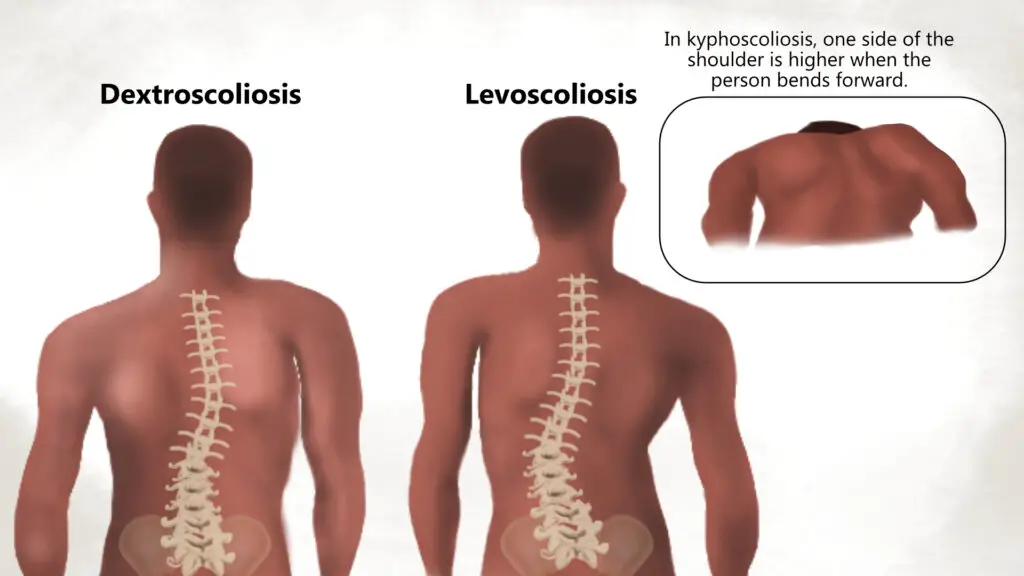
Kyphoscoliosis is an extreme form of spine deformity where there is an excessive rounding of the upper spine (kyphosis) and side-to-side curve in parts of the spine (scoliosis). This type of posture tends to have the back appear crooked or have the lower part of the spine curve inward toward the abdomen, which is more common among children and teens.
In some cases, one or more vertebrae are rotated. Kyphoscoliosis can cause you to have a hunched over appearance and may lead to breathing difficulties—it may reduce lung and vital capacity down to 30%—and other health complications, such as:
- Vertebral fractures
- Higher risk of falls
- Skin breakage/scabbing
- Paraparesis or paraplegia (paralysis/numbing)
Although most cases of kyphoscoliosis are congenital, some can develop or increase the risk. These include:
- Chronically hunched posture
- Spine malformation in infants and children since birth
- Weakness in spinal bones
- Abnormally shaped vertebrae
- Osteoporosis and cancer
Kyphoscoliosis affects 1 in 1,000 people on average, and every 1 in 10,000 patients develop a severe deformity that will impact their lives drastically. However, there are a few exceptions.
For example, last June in SIMS Hospital in Chennai, India, 15-year-old Tesfaye Mengesha Mersha was diagnosed with an extreme case of kyphoscoliosis, who was one of the few people who was completely cured of the deformity.
“The disease could cause heart and lung failure,” said Dr. K. Appaji Krishnan, who was the lead surgeon of the team performing the spine surgery. “[He] was successfully treated and the patient is all better and in a good condition now.”
Kyphoscoliosis can become fatal if not treated within reasonable time. For example, a 26-year-old Chinese woman in 2022 was suffering from both thoracolumbar spinal stenosis (narrowing of the spinal cord) and kyphoscoliosis, which was considered rare with little room for treatment options. The woman had no previous issues relating to spinal problems. However, two months prior to the hospital visit, the symptoms worsened. She could no longer stand or walk alone one month into the spinal pain.
After some testing, doctors discovered she was also suffering from pectus excavatum where the breastbone has sunken into her chest. The doctors have never seen all three deformities take place at once. To their knowledge, the caving of the breastbone due to a mix of kyphoscoliosis and thoracolumbar spinal stenosis has “not been documented previously.” Treatment options are “challenging because of its rarity,” they reported.
Does kyphoscoliosis cause back pain?
Kyphoscoliosis may cause back pain. Severe kyphoscoliosis is known for bending the spine inward, restricting any side-to-side movement. This can increase the risk of low back pain and further spine deformity.
For example, a 2016 case report from Pain Medicine reported a 57-year-old woman who suffered with “severe idiopathic kyphoscoliosis” and extreme back pain on the left curve of her lower spine. She didn’t want surgery because of “risks of neurological damage.” Therefore, the doctors attempted to follow through with physical therapy, which showed optimal results for the woman six months later.
Although different forms of kyphoscoliosis may cause back pain, it’s possible that some may not experience any spinal pain. However, research in the past 30 years found that posture alone is not a major cause of back pain.
In fact, researchers in 2020 pooled the data of 41 reviews and “found no consensus” that various body positions, such as prolonged sitting, standing, or bending, is a cause of low back pain.
“Kyphoscoliosis can be painful if the severity of the condition is high, if the deformity is advanced, and if it subsequently begins to cause other changes in the body due to the progressive sustained postural changes,” said Dr. Tanvi Maharaja, who is a physical therapist at Signature Healthcare Brockton Hospital in Boston, Massachuesetts.
She said while people with or without scoliosis have equal prevalence of back pain, research found patients with scoliosis “have many distinguished features of pain that correlate well with radiology.” They have:
- Femoral neuralgia
- Inguinal pain
- Extreme back pain if the lumbar spine rotates too much and the curve is severe
Is kyphoscoliosis a form of disability?
Kyphoscoliosis for both children and adults can be considered a disability legally if it’s severe enough, such as having an increased Cobb angle, a significant hump in the ribs, breathing and heart problems, severe arm pain, balance problems, and anything that interferes with daily living.
“In the adult patients, spinal deformities, such as extensor muscle weakness, vertebral compression fractures, facet joint changes…and sub-optimal bone health [may lead] to disability,” Maharaja said.
Children in the U.S. can qualify for scoliosis disability, and adults can enroll in SSI/SSD for benefits and accommodations. However, the patient must have severe kyphoscoliosis to qualify for disability. Minor kyphoscoliosis is still seen as early development and can be treated, therefore, disqualifying it.
Do you need a back brace?
Although it’s unnecessary to wear a back brace, studies suggest that it can help with the pain associated with scoliosis. However, a back brace is more efficient for young teens and children as their spine has not fully developed and can revert back from kyphoscoliosis.
A 2020 systematic review of studies from 1967 to 2018 found most studies reported “modest or significant reduction in pain,” and the patients seemed to have physically improved.
The limitations depends on the condition’s severity. Severe cases can result up to 24 hours of constant bracing, while minor forms can lead up to two hours of bracing. Overall, bracing can be used for kyphoscoliosis but usually under medical writing.
Kyphoscoliosis and EDS
Ehlers Danlos Syndrome (EDS) is hereditary tissue disorder that associates with:
- Abnormal stretching of the skin
- Unusual large movement of some or all joints
- Unusual scarring tissue
- Weak blood vessels that may cause bleeding under the skin
There have been links to kyphoscoliosis and EDS, better known as “kyphoscoliotic EDS”, which mostly occurs among children between infancy to age five. Although it’s the rarest form of EDS, it has similar traits as EDS in adults, including easy bruising and slow wound healing. Children with such conditions are described as “floppy babies” and had “a poor cry and difficulty in sucking.” This is due to muscle loss.
Further reading: What exercises are good for EDS?
How kyphoscoliosis is treated
Kyphoscoliosis is usually corrected by surgery. For those who prefer no surgery, there are other treatments and procedures that are based on age and the condition’s severity. These include:
- Pain management
- Respiratory management
- Cardiac management
- Bracing
- Physical therapy and exercise
- Spinal cord stimulation
“In severe cases with concomitant cardiorespiratory or spinal cord compromise, or with severe debilitating pain, spinal cord stimulation or surgery may be required,” Mahahraja said. “Various surgical approaches and techniques have been developed to address specific structural deformities and associated comorbidities. Post-operative pain management, physical therapy, and monitoring of neurological status are an integral part of post-surgical care.”
Children are usually monitored by an orthopedic doctor if the case is severe enough, but if it’s caught early on, they will be tested and monitored.
For asymptomatic or minimally-affected individuals, specialists can “simply closely monitor over time” the deformity growing, Majaraja said.
Physical therapy
Physical therapy may help reduce pain and improve movement and function for kyphoscoliosis patients, but the current research only examines kyphosis and lordosis.
A 2019 systematic review and meta-analysis reported that physical therapy can greatly reduce pain and may improve the spine’s posture. However, it doesn’t affect the lordotic lumbar angle much.
The researchers concluded that stretching regularly, specifically the kyphosis angle, may help reduce the pressure and pain. The study also reported that two to three sessions per week for eight to 12 weeks show a significant difference. A specialist may require longer or shorter sessions, depending on the severity.
Exercise
Exercise depends on the state of kyphoscoliosis and pain tolerance. For scoliosis, exercise may help improve the spine’s posture as long as it’s not right after surgery.
Spinal cord stimulation
Spinal cord stimulation (SCS) is recommended to patients who don’t want surgery for kyphoscoliosis. SCS is an implanted device that sends small electrical shocks to the spine and is often a “last resort” due to its potential complications. It may cause “potential technical difficulties” once implanted. However, if done correctly with careful evaluations and testing, SCS can be one of the best options for pain relief for patients with kyphoscoliosis.
Social support
For those who need mental health and social support, there are some options:
- National Scoliosis Foundation (NSF): The NSF provides support from doctors, nurses, and volunteers to answer questions or talk to patients. They also have resources available, including materials and screenings.
- Scoliosis SOS Clinic: This group provides different support groups worldwide, including the U.K., the Netherlands, and Nigeria. They provide online links and phone numbers to contact.
Living well with chronic pain
Having kyphoscoliosis doesn’t mean you should live with constant suffering. Living well with chronic pain is a theory created by Dr. Bronnie Lennox Thompson to help those who suffer with chronic pain.
Living well with chronic pain consists of a clear diagnosis, understanding symptoms, coping skills, and future planning. Thompson uses different processes to help her patients who tell themselves that “I don’t feel like myself anymore” to better their lives and manage their chronic pain.
Patients may start with either a diagnosis or understanding symptoms and instigate the person to start future planning and coping with their new lives in a positive direction.
There is no “right way or wrong way” to figuring out what works as long term self healing with any chronic pain, Thompson said. “Patients who are diagnosed with kyphoscoliosis should have the opportunity to live a happy and pain-free life, especially if they decide to not go forward with surgery.”
Dezare Lozano
Dezare graduated from of San Diego State University in 2025 where she earned a degree in journalism with a minor in English. During her studies, she emphasized news writing and gained experience reporting and producing news stories.
Dezare is focused on expanding her skills across additional areas of journalism, including working in a newsroom at a large newspaper organization and traveling to capture compelling photojournalism. She also aspires to become a journalism professor in the future.
In her free time, Dezare enjoys sharpening her camera and writing skills. She also likes cooking, animating, and working on creative writing side projects.