Key takeaways
- Mechanical tension and mechanotransduction are currently the strongest evidence-based explanations for how muscles get bigger.
- Current evidence suggests that anabolic hormones, cell swelling (“pump”), and metabolites have little to no effect on muscle hypertrophy.
- A Canadian exercise scientist suggests a few ways for academics and others to disseminate better information.
~~~~
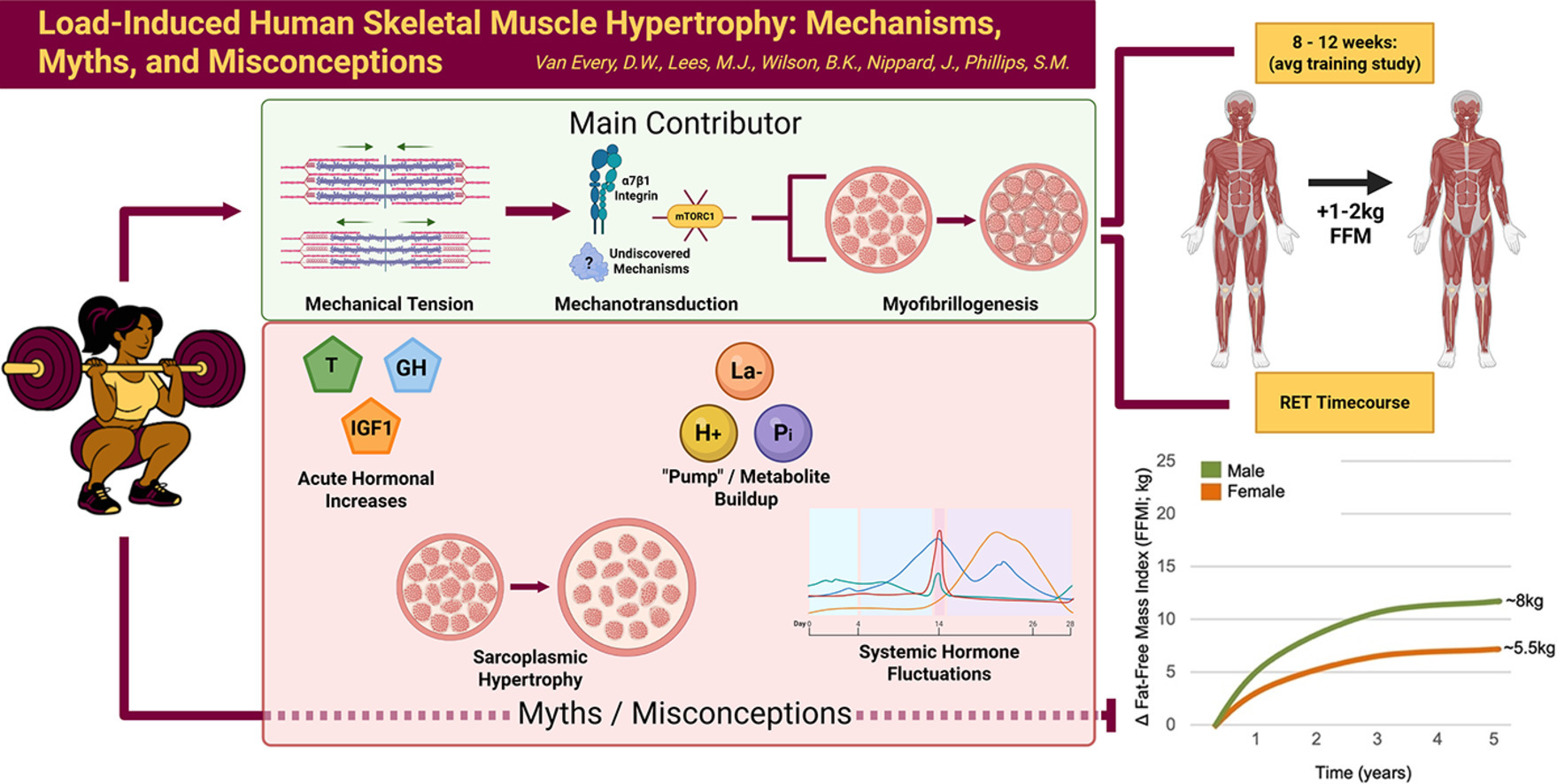
Several Canadian researchers identified several myths about muscle hypertrophy that still persist in sports and fitness industries. Published in Journal of Health and Sports Science, researchers Derrick Van Every and his colleagues wrote that muscle hypertrophy is “predominantly driven by mechanical tension and the activation of mechanotransductive intracellular signaling cascades.” The latter refers to how muscles convert tension and load into chemical signals that drive muscle growth.
“While several mechanisms—such as endogenous hormonal elevations, metabolite accumulation, cell swelling and sarcoplasmic hypertrophy—have been proposed as meaningful contributors to hypertrophy, the current evidence does not support these as factors promoting muscle growth,” Every et al. concluded.
Hormones
The researchers wrote that claims about acute increases on anabolic hormones (e.g. testosterone, growth hormones, insulin-like growth factor 1 (IGF-1)) from resistance training “yielded no support” based on several studies:
- A 2009 study of eight young men found anabolic hormones “do not enhance fed-state anabolic signalling or [muscle growth] following resistance exercise.” The participants trained one arm flexor muscle at a time using resistance exercise under two different conditions: one designed to keep anabolic hormone levels low and one designed to spike them significantly.
- Even though the high-hormone condition produced anabolic hormone levels that were four to five times greater, there was no meaningful difference in muscle protein synthesis rates or the activation of key signaling proteins between the two groups, according to the researchers.
- The experiment was repeated for 15 weeks of training with 12 young men, and the researchers found similar results: Resistance training “increases in endogenous purportedly anabolic hormones do not enhance muscle strength or hypertrophy…”
- In 2012, a 12-week study of 56 young men found no correlation between the increase of anabolic hormones and leg muscle mass and strength.
Every et al. wrote that if systemic hormones were the primary regulators of muscle hypertrophy, one would expect men to gain significantly more muscle growth than women from resistance training.
They wrote that although women have a 10- to 20-fold lower testosterone and up to 200-fold lower free testosterone concentrations than men, “multiple meta-analyses have reported similar relative increases in muscle mass and strength following [resistance training].”
In one 2025 meta-analysis, Refalo et al. reported men gained greater type I muscle fibers and upper-body muscles than women, but both genders increased similar amounts of type II muscle fibers.
Meanwhile, Every et al. cited a 2020 systematic review and meta-analysis of 30 studies that found post-menopausal women also gained similar relative muscle mass as men their age.
They wrote that long-term exposure to lower testosterone and estrogen levels “does not impair responsiveness to [resistance training], which refutes the concept that systemic hormonal fluctuations within physiological ranges meaningfully influence [resistance training]-induced hypertrophy.”
Metabolites
Metabolites are byproducts produced during the chemical reactions the body uses to generate energy. For example, when you run a marathon or do heavy, manual labor for several hours, your muscles produce substances like lactate and hydrogen ions as a result of glucose breakdown for fuel when oxygen supply is limited.
Every et al. wrote that while such metabolites are often claimed to induce muscle hypertrophy, the claim is “difficult to locate.” They explained that muscles rely much on a fast-acting energy system that produces metabolites during resistance training. As these byproducts build up inside the muscle, this accumulation acts as a trigger for muscle growth, especially during lighter resistance training with higher reps, which activates pathways that promote hypertrophy. “[This results] in a response comparable to that of high-load [resistance training].” they wrote.
Every et al. wrote that bodybuilding-style training, which is structured to maximize metabolic stress through moderate weights and short rest periods, produces similar hypertrophy to heavier powerlifting-style training when total volume is equated. Some lab studies also show that lactate may enhance anabolic signaling, but the authors cautioned that “correlations observed do not imply causation,” and that no human study has been specifically designed to isolate the effect of metabolites independent of muscle contraction itself.
More direct tests have largely come up empty. For example, a 2020 study found that infusing sodium lactate in 16 participants while they performed a one-legged resistance exercise did not change muscle pH level, anabolic hormone signaling, or muscle protein synthesis rates—even though blood lactate concentration was about 130% higher.
The researchers concluded that metabolites may contribute indirectly by causing muscle fatigue, which forces the body to recruit more higher-threshold motor units. This recruitment then drives mechanotransduction across more muscle fibers, which is the actual growth stimulus.
[Related: Does stretching increase muscle size?]
Cell swelling
Cell swelling — also known as “the pump” among bodybuilders — does not contribute to muscle hypertrophy, according to Every et al. The wrote that the pump refers to the increase in interstitial fluid pressure, which may stimulate muscle protein synthesis and reduce muscle protein breakdown.
However, Every et al. highlighted that the mechanism was studied in non-muscle cells, which “lack [extracellular matrix] lattice that would normally constrain myofibers,” making it unclear whether the same effects would occur in actual muscle tissue.
They also cited two human studies on cell swelling. One study found greater acute muscle swelling after a single session of leg extension over six weeks, with cellular swelling explaining about 25% of the variance in muscle growth.
Another study reported a significant positive correlation between swelling and hypertrophy, but that study was only published as an abstract and used a protocol of 100 reps per set, which limits how applicable it is to normal training, according to Every et al.
They wrote that the pump as people experience it in the gym is entirely subjective and “does not accurately indicate the degree of actual cell swelling.”
Sarcoplasmic hypertrophy
Sarcoplasmic hypertrophy is the expansion of the non-contractile contents of a muscle fiber, such as fluids, glycogen, and supporting proteins that fill the space around the myofibrils, which are the actual force-producing structures. Every et al. wrote that sarcoplasmic hypertrophy — if it does make muscles bigger — plays a minor role compared to the accumulation of new contractile proteins (actin and myosin) within muscle fibers.
They also suggested that the concept of sarcoplasmic hypertrophy “is not a separate form of hypertrophy but rather a remodeling of the sarcoplasm that occurs in concert with myofibrillar hypertrophy.” They added that the ratio of sarcoplasmic to myofibrillar protein is unlikely to meaningfully change with different types of resistance training.
Sarcoplasmic hypertrophy’s idea is that certain training styles, particularly higher-rep bodybuilding-type training, may cause muscle growth by increasing this non-contractile fluid and protein content rather than adding more contractile fibers. Every et al. wrote that this is why bodybuilders can have larger muscles than powerlifters without being proportionally stronger.
They added that glycogen and intracellular water retention are also proposed contributors since glycogen binds several grams of water per gram stored, potentially inflating muscle size without adding contractile tissue.
[Related: How do muscles contract without changing length?]
So what works?
Every et al. proposed two strong evidence-based mechanisms to muscle hypertrophy: mechanical tension and mechanotransduction.
Mechanical tension
Mechanical tension is “force generated by muscle fibers during active contraction or passive stretch,” Every et al. wrote, which refers to concentric and eccentric contractions, respectively. They wrote that mechanical tension stimulates an enzyme called mTOR, which starts a chain reaction that stimulates muscle and metabolic adaptations. However, they noted that this mechanism has not been verified in humans.
Every et al. reported that mechanosensors within muscles appear to respond differently depending on the type of mechanical stimulus applied. Passive stretching tends to add more sarcomeres along the length of the muscle fiber, while resistance training increases the fiber’s cross-sectional area.
From a practical standpoint, “mechanical tension and thus skeletal muscle hypertrophy can be obtained across a wide range of loads, allowing for versatility in program design,” they wrote.
Dr. Stuart Phillips of McMaster University, who co-authored the research paper, told Massage & Fitness Journal that muscle hypertrophy can be “generated across a broad spectrum of loads,” roughly from 30% to more than 85% of one-repetition maximum, provided sets are taken close to failure.
“That gives clinicians and coaches a lot of room to individualize,” he said.
Phillips gave an example where a physical therapist might not use heavy loading with a post-surgical knee patient or an older adult with painful joints.
“They can still drive meaningful hypertrophy using lighter loads (e.g., 30% to 50% of one-rep max) for higher repetitions, as long as effort is high and the sets approach muscular failure,” Phillips said. “This is also where blood flow restriction can be useful because it lets the patient achieve a hypertrophic stimulus at loads that protect healing tissues. The mechanism, importantly, is still mechanical tension on recruited fibres, not metabolites per se.
In a fitness setting, Phillips said the same principles in loading and program versatility can be applied to a personal trainer working with a healthy client.
“A client who hates grinding heavy singles and doubles can train mostly in the eight to 15 rep range and still grow [muscles] well,” he said. “A client who finds long sets miserable can use heavier loads for fewer reps. A busy client can shorten sessions by using moderate loads and pushing closer to failure on fewer sets.”
He added that having sufficient effort and volume over time with progressive overloads matters more than a specific load.
“So the take-home for practitioners is that load is a tool you select based on the person in front of you (their joints, their training age, their preferences, their schedule), not a fixed prescription,” he said. “As long as effort and volume are adequate, hypertrophy will follow.”
Mechanotransduction
When you lift weights, mechanical tension is applied to muscle fibers. But that force doesn’t just travel in one direction — it moves parallel to the fibers and laterally through the surrounding connective tissue called the fascia matrix. While the mechanism is unclear, Every et al. identified several mechanosensor proteins that convert tension to molecular signals that regulate anabolic and catabolic pathways within muscle cells.
- Extracellular matrix (ECM): “Scaffolding” that surrounds cells that acts as a “central coordinator” by receiving mechanical signals which influences whether the muscle grows, maintains, or breaks down.
- α7β1-integrin: A mechanoreceptor in the sarcolemma and ECM that may contribute to muscle hypertrophy.
- Focal adhesion kinase (FAK): An enzyme within costameres (proteins that attach the sarcomeres to the sarcolemma) whose expression increases during mechanical loading. However, its direct relationship with α7β1-integrin remains unconfirmed.
- Titin: A large elastic protein that generates passive force during eccentric contractions and contains a stretch-activated enzyme that activates when the sarcomere is stretched.
- Phospholipase Cγ1: An enzyme that acts like a middleman inside muscle cells in cell signaling. When it’s activated, it takes a molecule called phosphatidylinositol 4,5-bisphosphate and splits it into two smaller signaling molecules. These molecules act like text messages sent deeper into the cell, triggering it to do various tasks, such as releasing calcium or activate other proteins.
- Phosphatidic acid: A lipid signaling molecule produced during mechanical tension that activates the Hippo pathway and mTORC1, which leads to muscle hypertrophy. mTORC1 is a subtype of mTROC that promotes nutrient and energy uptake, which drives cell growth.
The Hippo pathway promotes cell development, growth and differentiation. It involves two types of proteins, YAP and TAZ, that activates mTORC1.
“Despite significant progress, our understanding of mechanotransduction in [resistance training]-induced hypertrophy remains incomplete,” Every et al. wrote. “Nevertheless, mechanical tension is widely recognized as the primary driver of muscle growth, but the undiscovered interplay between different molecular sensors and signaling pathways presents exciting opportunities for future research.”
Improve public outreach
Despite the misconceptions and myths about muscle hypertrophy that permeate in the fitness and manual therapy professions, Phillips said that there are some things that can improve better information to spread.
“The fitness information ecosystem rewards novelty and certainty, and evidence-based messages are often neither,” he said. “‘It depends,’ and ‘effort matters more than the specific load’ [don’t] sell supplements or training programs.”
Phillips said researchers need to consistently show up in spaces where coaches and trainees tend to congregate, such on YouTube, podcasts, and Instagram, not just scientific journals. He noted that he invited professional bodybuilder and powerlifter Jeff Nippard as a co-author because he has a reach of more than 2 million followers “who will never read the Journal of Sport and Health Science.”
“And he does it with evidence-based content,” Phillip said.
Phillips also cited that having open-access publishing helps reduce myths and promote more accurate information. “This review is open access, which means coaches, trainers, and journalists like yourself can actually read it without paywalls. More researchers should prioritize that,” he said.
Another problem is that decades-old myths persist because people on social media speak with “total confidence” about muscle hypertrophy mechanisms that the scientific literature doesn’t actually say, according to Phillips.
“We need to be honest in public communication about what we don’t know,” he said, adding that journalists should read the original literature and “ask good questions” rather than just summarizing press releases.
Therefore, Phillips recommended saying something like “The best evidence suggests X, and here’s where the uncertainty [is]” is a model for intellectual humility.
“[It] is contagious if enough credible voices do it,” Phillips said.
Finally, Phillips said that personal training certification and physical therapy continuing education could improve by updating their curricula.
“A lot of what gets taught in entry-level coaching courses is 20 to 30 years out of date,” he said.

Nick Ng, BA
Nick Ng is the editor of Massage & Fitness Jounal and the managing editor for My Neighborhood News Group.
An alumni from San Diego State University with a bachelor’s degree in graphic communications, Nick had also completed his massage therapy training at International Professional School of Bodywork in San Diego in 2014. In 2021, he earned an associate’s degree in journalism at Palomar College.
When he gets a chance, he enjoys weightlifting at the gym, salsa dancing, and exploring new areas in the Puget Sound area in Washington state.