Feature Articles

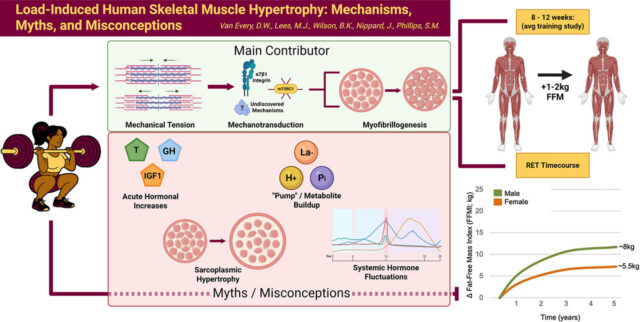
Mechanical loading still reigns for muscle hypertrophy, scientists say. Hormones, ‘pump,’ not so much

Key takeaways Mechanical tension and mechanotransduction are currently the strongest evidence-based explanations for how muscles get bigger. Current evidence suggests that anabolic hormones, cell swelling (“pump”), and metabolites have little to no effect on muscle hypertrophy. A Canadian exercise scientist suggests a few ways for academics and others to disseminate

Read more »
muscle contraction myofibrils sarcomeres

How do muscles contract without changing length?

Although we still have a lot to learn about how muscles contract, we do understand the basics of how the nervous system initiates a series of actions that contract a muscle. What about muscle movements that we don’t consciously decide to make, like breathing, digestion, and heartbeats? And what about

Read more »

Researchers challenges ‘get stronger’ message in pain treatment

A 2025 editorial published in the British Journal of Sports Medicine argued that increasing muscular strength is not the main driver for reducing pain. Instead, they wrote that strength training is one component among several factors that contribute to pain reduction, based on the biopsychosocial framework of pain. These other

Read more »
massage therapist giving a woman an abdominal massage for inguinal hernia pain relief

Can you massage an inguinal hernia back in place?

An inguinal hernia occurs when a weakness in the lower abdominal wall at the inguinal canal allows the contents of the abdomen to bulge through the rupture. “Hernia,” from the Latin for “rupture,” is used to describe several conditions in your body, and inguinal hernia is one of the most

Read more »
physical therapist pnf stretching hamstrings

PNF stretching: How to do it and what research says

Proprioceptive neuromuscular facilitation, or PNF, is a type of stretching that involves a muscle to repeatedly contract against resistance and then relaxed into a deeper stretch, using the nervous system to allow greater lengthening. In practice, a practitioner or partner takes a limb into a passive stretch. Then the athlete contracts

Read more »

Why stretching theories lean toward neural explanations, less mechanical

While stretching is often recommended by many fitness, sports, and rehab professionals, few could explain how it works and why. Traditional explanations often include “it lengthens your muscles” or “releases fascia.” However, research in the last 30-plus years has shown that stretching is less about mechanical properties and more about

Read more »