Active stretching is where you take a muscle group you want to stretch and contract its opposite muscle group without using external support. The objective isn’t necessarily to increase your flexibility; rather, it’s a way to prepare for the upcoming activity.
For example, if you want to stretch your hamstrings, you lie on the floor and raise one leg as high as you can until you feel a stretch. You contract your quadriceps for a few seconds, relax the contraction, and lower your leg. Then you repeat this process a few times.
Some sources say that active stretching is more than just increasing flexibility; it’s a way to warm-up and prepare your muscles for whatever activity you are going to do. However, what does scientific evidence say about active stretching and athletic performance?
Active stretching vs. static stretching
First, active stretching is just a type of stretching while static stretching is where you hold a stretch in a fixed position for about 20 to 30 seconds. Some guidelines for stretching, such as the one by the National Strength and Conditioning Association, could be applied to active stretching.
Active stretching vs. passive stretching
Unlike passive stretching, active stretching does not need external forces to increase range of motion. Instead, when you “actively” contract a muscle group, you “relax” the opposite muscle group which allows more range of motion. This idea is based on reciprocal inhibition, where the targeted muscles are under voluntary contraction, and the opposite muscles have reduced neural activity which allows the muscles to stretch further.
However, one Brazilian study in 2011 found that there is hardly any differences in knee extension flexibility between active and passive stretching among 60 men. Therefore, not all theories may apply for every person or group.
What is active isolated stretching?
Active isolated stretching, or AIS, is a more specific type of active stretching that involves stretching a muscle for no more than 2 seconds and then return to its neutral position. This is repeated several times in intervals.
Another difference is that you can do AIS with a partner or a tool that helps you stretch—like a resistance band or a half foam roller.
There aren’t a lot of research that support whether AIS can improve specific types of sports and activities, nor are there any critical and systematic reviews yet. So, no one really knows if AIS is better (or worse) than other types of stretching.
Active stretching exercise examples
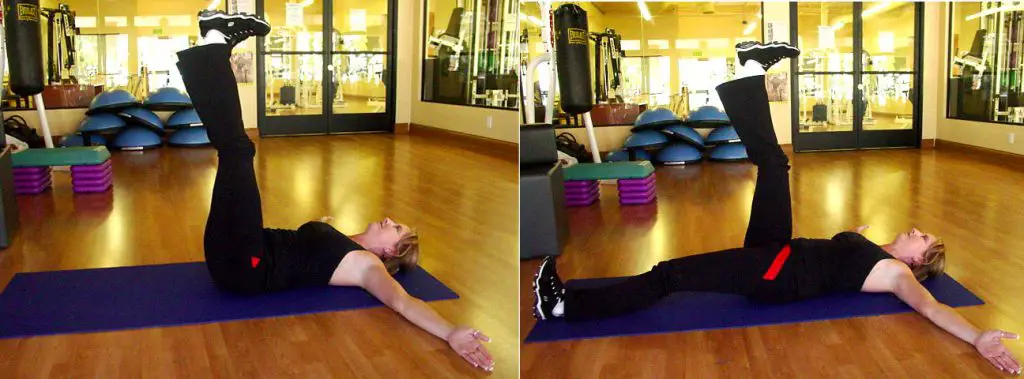
Supine hamstrings stretch with quadriceps contraction
- Lie on the floor on your back with both legs extended toward the air with your knees slightly bent.
- Flex your toes toward your face. Lower one of your legs toward the ground while keeping the other leg in the same position by contracting your quadriceps.
- Stop lowering when you feel a stretch in the opposite hamstrings.
- Hold this position for about 10 to 15 seconds, and then raise your leg back to its starting position.
- Repeat for 5 to 6 times one each leg for 2 to 3 sets.
Thoracic mobility
See video for demo.
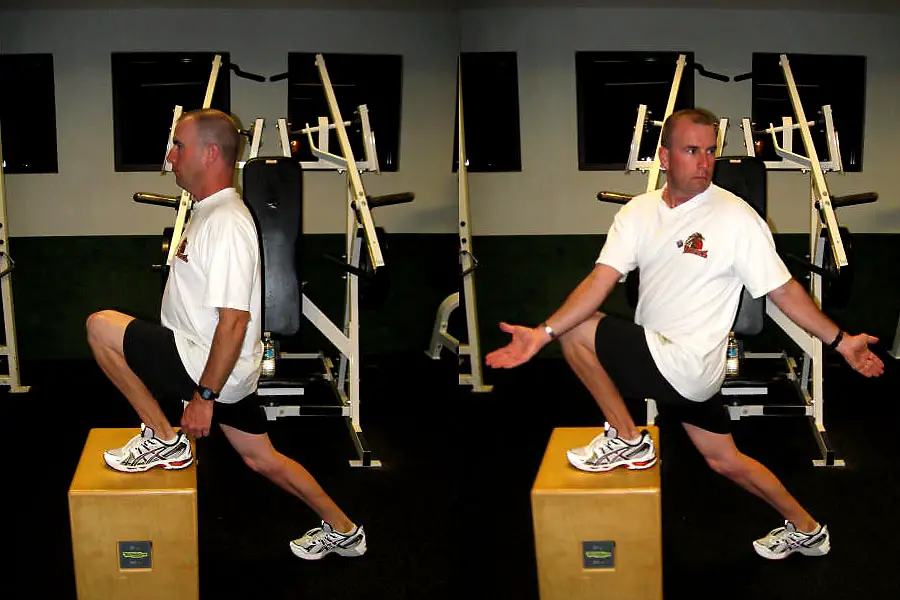
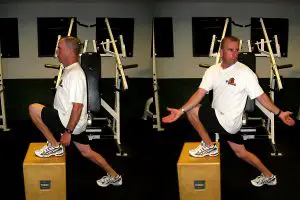
Lunge hip flexor stretch with glute contraction
- Stand with one foot on top of a 2- to 3-foot high box or step, and lean your weight toward the front foot.
- Contract your glutes to increase the stretch in your hip flexors for 4 to 5 seconds.
- Shift your weight back to the starting position ,and repeat the stretch on the opposite side.
- Repeat for 2 to 3 sets.
You may include stretching your lower back turning your torso toward the flexed hip as you hold the stretch.
Biceps stretch with triceps contraction
- Extend your right arm to your side with your right palm facing away from your body.
- Contract your triceps as you stretch for 4 to 5 seconds. Tilt your head to you left to increase the stretch if needed.
- Repeat the stretch on the opposite side, and repeat it for 2 to 3 sets.

Scientific evidence for active stretching
A 2012 review compared previous research on active stretching and passive stretching on muscle loss prevention. A majority of the research—in animal and human studies—found that passive stretching had little to no effect on preventing muscle atrophy, but active stretching could.
However, a few human studies that they summarized do find benefits of passive stretching, such as “significant changes in knee extension range of motion.” Passive stretching has been shown to decrease muscle stiffness for 10 to 20 minutes and improve greater range of motion in knee extension than dynamic stretching.
Although the literature offers mixed results, the weight of the current evidence leans toward active stretching as one intervention to minimize muscle atrophy. This could be beneficial for those who are bed-ridden or recovering from an injury.
More recent research, however, found contradicting evidence to the 2012 review. In a 2015 study, researchers compared the effects of passive stretching and active stretching on hamstrings flexibility. A total of 54 subjects were randomly selected for the passive, active, or control group with nine men and nine women in each group.
In the experimental groups, they laid on their back and bent their hips and knees at about 90 degrees as their starting position. They gradually extended their knee until they started to feel a stretch in the hamstrings.
In the passive stretching group, a researcher extended the knee further to a tolerable stretch.
In the active stretching group, the subjects extended their own knee by contracting their quadriceps.
In both groups, the stretch was held for 10 seconds and flexed the knee slowly for 10 seconds. They repeated the exercise for 3 sets. The control group did not stretch.
While both experimental groups had improved flexibility and the control group hardly had any increase, the researchers measured the results and found that the passive stretching gained more than double the amount of knee flexion (+15.8 degrees) than the active stretching group (+7.0 degrees).
The drawbacks of this research include having young, healthy subjects in their twenties, so the study may not apply older populations.
“If you look at all the research, it’s really an ‘it depends’ situation,” said Dr. Allan Bacon, who is co-owner of Maui Athletics in Hawaii. “If you have decreased flexibility, passive stretching is probably something that could help but probably isn’t the greatest thing to do before exercise. It’s probably better to do that post-exercise when you’re a little bit warmer and looser. ”
Bacon recommends that most of his clients do active stretching before a workout because that will “bring them to their end range of motion.”
“They do not need to achieve maximal flexibility if their sport or activity does not demand it,” he said.
Edited for conciseness and clarity on July 23, 2026.

Nick Ng, BA
Nick Ng is the editor of Massage & Fitness Jounal and the managing editor for My Neighborhood News Group.
An alumni from San Diego State University with a bachelor’s degree in graphic communications, Nick had also completed his massage therapy training at International Professional School of Bodywork in San Diego in 2014. In 2021, he earned an associate’s degree in journalism at Palomar College.
When he gets a chance, he enjoys weightlifting at the gym, salsa dancing, and exploring new areas in the Puget Sound area in Washington state.