Pain science has leaned on a familiar aphorism: Nociception is neither necessary nor sufficient for pain. The phrase typically appears in textbooks, lectures, and research papers, often used to explain why pain can exist without clear tissue damage. But according to pain researchers Asaf Weisman, Dr. Milton Cohen, and Dr. John Quintner, that aphorism—an “expression of general truth”—is no longer defensible.
In their paper, “Adieu to an Aphorism: Why Nociception Is Necessary for Pain,” the authors argued that the pain science field has accepted a simplified slogan in place of a biological explanation about how pain works. Their conclusion is that nociception is necessary for pain, even though it is not sufficient to explain the experience of pain on its own.
Weisman and his colleagues said the aphorism creates a direct conflict with how pain itself is defined. “We recognised that the aphorism actually challenges the IASP [International Association for the Study of Pain] definition of pain, which prescribes an association with ‘tissue damage’—or, preferably, as we argue, with nociception,” Weisman told Massage & Fitness.
The group also found that the claim that nociception is “not necessary” for pain no longer fits with modern scientific knowledge. “The ‘not necessary’ part of the aphorism is incompatible with many current scientific and clinical observations,” Weisman said, prompting the authors to examine how the field first arrived at this conclusion.
According to the authors, the aphorism emerged when clinicians and researchers encountered pain conditions that were difficult to explain biologically. “The aphorism seemed to have served the purpose of filling the vacuum created by clinical and scientific phenomena that were difficult to explain,” Weisman said. Since then, advances in anatomy and physiology have narrowed that gap. The problem, he added, is that “the current concept of nociception is too narrow.”
Weisman said aphorisms are “seductive in their simplicity,” and that simplicity may have delayed deeper inquiry.
Evidence of pain without nociception
Weisman and his colleagues focus on the lack of rigorous evidence supporting claims that pain can occur without any nociception. Weisman emphasized that the burden of proof rests with those making that claim.
He said to meet that burden, experiments must first control for demand characteristics, such as the subtle cues that lead participants to respond in ways they believe are expected. “If participants know a study is about pain, they might report pain simply because they believe that’s what they’re supposed to do,” he said.
Beyond that, Weisman argued that laboratory studies attempting to induce pain with innocuous stimuli must meet the same standards expected in pharmacological research. These studies should be “cross-over placebo-controlled” and include “arms in which actual analgesic medications are given randomly to participants to make sure that possible nociceptive activity is eliminated or diminished to a minimum,” Weisman said.
Without such controls, reports of pain do not demonstrate pain without nociception, which demonstrate methodological weakness, the authors wrote.
Phantom limbs and persistent misinterpretations
Phantom limb pain is often cited as the strongest evidence that pain can exist without nociception,but Weisman called this reliance puzzling. “In the last 20 years or so, the neuroanatomical basis for phantom limb pain has been elucidated,” he said, undermining the idea that the phenomenon lacks biological grounding.
The authors also pointed to the evidence surrounding congenital limb aplasia, a rare condition in which a person is born without part or all of a limb. Despite long-standing assumptions in pain science, they note that phantom pain has not been reliably demonstrated in people born without limbs. In other words, the experience of pain in a limb that never developed appears to be far less common than often claimed.
The authors wrote, “Phantom pain has in fact not been demonstrated in cases of congenital limb aplasia,” which raises questions about how evidence has been selectively used to support long-standing theories about pain and the brain.
The authors also pointed to evidence surrounding congenital limb aplasia, a rare condition in which a person is born without part or all of a limb. Despite common assumptions, they noted that phantom pain has not been reliably demonstrated in people born without limbs.
“Phantom pain has in fact not been demonstrated in cases of congenital limb aplasia,” they wrote.
Research on people born with limb differences, including clinical reports published in Brain, suggests that phantom sensations are far less common in congenital cases than in those who lose a limb later in life. For the authors, this raises questions about how selectively evidence has been used to support certain theories about how pain is generated in the brain.
The paper also critiques experimental paradigms like the rubber hand illusion and the thermal grill illusion, which are often invoked as demonstrations of pain without nociception.
“The problems behind experiments on these phenomena are logical, conceptual, and methodological,” Weisman said. In many cases, researchers assume they are studying “illusions” without first establishing that the experience meets the criteria of an illusion. He said this amounts to “the fallacy of begging the question,” where the conclusion is assumed from the outset.
Allodynia
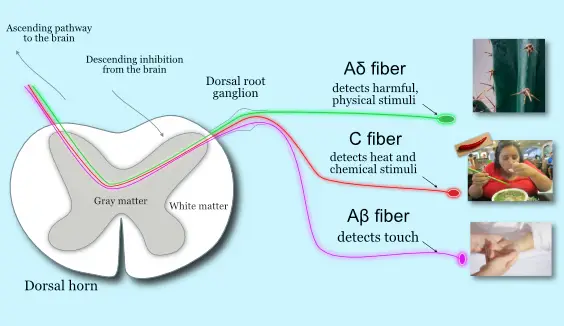
Clinically, the authors are concerned with how allodynia — pain triggered by stimuli that are not normally painful, such as light touch — is interpreted and communicated. Allodynia is never independent of biology, they said. “Allodynia should be understood as a phenomenon that is always dependent on activation of the nociceptive apparatus,” Weisman said.
In acute pain, this sensitivity may be adaptive. In chronic pain, however, “allodynia in normal tissues is a clue to persisting sensitisation of the nociceptive apparatus,” Weisman said.
Framing allodynia as evidence that the brain can generate pain without nociception misrepresents both the biology and the patient’s experience, the authors wrote.
Nociplastic pain and the limits of current definitions
The debate over nociception also has implications for how clinicians understand nociplastic pain — a category used to describe pain that cannot be explained by clear tissue damage or nerve injury. Weisman and his colleagues do not reject nociplastic pain as a clinical reality. They suggest that rigid distinctions between pain categories may obscure the underlying processes that shape a patient’s experience, particularly when pain is understood through isolated mechanisms rather than as part of an interacting system.
“Nociplastic pain is actually defined as ‘pain that arises from altered nociception,’” Weisman said. The fact that these phenomena exist but cannot be explained by current definitions suggests that “either ‘nociplastic pain’ is invalid (which we do not believe) or nociception needs to be redefined.”
That redefinition involves shifting from individual nociceptors to a broader nociceptive network. Weisman said that labels like nociceptive, neuropathic, and nociplastic “are not descriptors of a pain experience but rather of mechanisms of engagement of nociception.”
Why this matters in the clinic
Weisman and his colleagues wrote that broadening the concept of nociception has tangible benefits. “It will confer legitimacy for patients who are now being told that there is nothing wrong with them or that their pain is due to psychological processes,” Weisman said. It may also “help to promote the development of therapeutics, including biologicals, targeted to different levels of the nociceptive apparatus.”
For conditions such as fibromyalgia, nonspecific low back pain, and irritable bowel syndrome — often labeled “functional” or “nonspecific” — this reframing shifts the clinical question. Rather than asking whether nociception is involved, clinicians may instead ask how pain-related signaling is being amplified or sustained.
In practice, that could mean acknowledging pain as biologically real even when imaging is unremarkable, while addressing mood, stress, and prior pain experiences as part of care rather than as explanations that dismiss symptoms.
Rethinking pain education
Weisman and his colleagues believe pain education must change accordingly. “Clinicians should be aware that any complaint of pain must be linked to engagement of nociception,” he said. In practice, that means clinicians still carry the responsibility of explaining pain in biological terms, even when no clear tissue damage is present.
Weisman said perhaps the most persistent misunderstanding is the assumption that he and the authors are dismissing psychosocial factors. “All that we are asserting is that nociception is necessary for pain,” he said. “However, nociception is not sufficient for pain, and it is here that the role of psychological and social determinants of the pain experience comes into play.”
The authors argued in the paper that reaffirming nociception’s necessity does not weaken the biopsychosocial model—it strengthens it. “Potentially all pain complaints can be explained at the biological level without undermining the assessment and treatment of people experiencing pain within a biopsychosocial framework,” Weisman said.
In saying farewell to a familiar aphorism, the authors are not simplifying pain. They are asking the field to take its biology seriously again.

Dezare Lozano
Dezare graduated from of San Diego State University in 2025 where she earned a degree in journalism with a minor in English. During her studies, she emphasized news writing and gained experience reporting and producing news stories.
Dezare is focused on expanding her skills across additional areas of journalism, including working in a newsroom at a large newspaper organization and traveling to capture compelling photojournalism. She also aspires to become a journalism professor in the future.
In her free time, Dezare enjoys sharpening her camera and writing skills. She also likes cooking, animating, and working on creative writing side projects.