A 15-year Canadian study of 889 patients with colon cancer found that those who exercised regularly had about a 25% lower risk of cancer recurrence and death over a five-year period than the control group who received health education.
Published in the New England Journal of Medicine in 2025, the study also reported a 6.4% difference in survival rate: 80.3% in the exercise group, 73.9% in the control group. This means out of every 100 patients who exercised, six or seven more remained cancer-free at five years compared to controls.
Similar studies and reviews have shown that regular exercise, such as running, cycling, walking, and strength training, can reduce the risk of several different types of cancer.
According to a 2019 U.S. and Canadian systematic review, the researchers found “strong evidence that physical activity reduces the risk of cancers of the breast, colon, endometrium, bladder, stomach, esophagus, and kidney.” That study reviewed 45 meta-analyses, systematic reviews, and pooled analyses on physical activity levels and cancer risk.
However, the evidence was “moderate” for lung cancer, “limited” for prostate, blood, ovarian, head and neck, and pancreatic cancer, and “insufficient” for brain cancer.
Led by Dr. Anne Tiernan from Fred Hutch Cancer Research Center in Seattle, Washington, the researchers added that data on physical activity affects survival after cancer is still developing. Early findings suggest that people with breast, colon, or prostate cancer who are more active may have about a 40%–50% lower risk of death compared to those who are less active.
The big picture: Exercise and cancer risk
McTiernan and her colleagues found that some types of cancer have similar risk reductions while some do not because of limited evidence.
Bladder cancer: Exercise lowers relative risk by 15% of developing bladder cancer based on two meta-analyses/systematic reviews and one pooled analysis. Absolute risk was not reported.
Breast cancer: Based on a 2016 meta-analysis, people who were the most active had a 12% lower relative risk of getting breast cancer than those in the least active group. Similar risk reductions were seen across activity types and for both premenopausal and postmenopausal women. More recent meta-analyses and several cohort studies confirmed this protective effect, but the results were mixed for activity during childhood and adolescence or early female reproductive years.
Colon cancer: Based on eight meta-analyses/systematic reviews and one pooled analysis, there is a 19% lower relative risk of getting colon cancer.
Endometrial cancer: Based on four meta-analyses/systematic reviews and one pooled analysis, there is a 20% lower relative risk of getting endometrial cancer in exercise of all intensity levels.
Esophageal cancer: Based on three meta-analyses/systematic reviews and one pooled analysis, there is a 21% lower relative risk in getting esophageal cancer. However, exercise was not related to the risk of getting squamous cell carcinoma of the esophagus.
Gastric cancer: Based on five meta-analyses/systematic reviews and one pooled analysis, there is a 19% lower relative risk in getting gastric cancer.
Renal cancer: Based on one meta-analysis/systematic review and one pooled analysis, there is a 12% lower relative risk in getting renal/kidney cancer.
Lung cancer: There is a 25% lower relative risk in getting lung cancer; however, the researchers reported they “could not rule out effect modification by tobacco use” and considered the evidence to be “moderate grade.”
This is because when people were grouped by smoking status (never, former, or current smokers), the benefit sometimes disappeared. That makes it unclear whether exercise truly lowers risk in smokers, nonsmokers, or both.

Other cancers: There is limited evidence to suggest that exercise has any significant effect on other types of cancer, such as blood, ovarian, head and neck, pancreatic, brain, and prostate.
McTiernan and her colleagues reported they weren’t able to determine the exact levels of physical activity because of the “inconsistent methods of measuring and categorizing physical activity” in all the studies reviewed.
Despite that limitation, McTiernan and her colleagues wrote, “Almost any level of physical activity likely confers some benefit.”
Also, there was little data on people who were non-white. There was some data on people of Asian and African ancestry, but the researchers reported “sparse” data for Latinos, Native Americans, and Pacific Islanders.
Dose-relationship of exercise and cancer risk
While McTiernan and her colleagues wrote that the exact dose-response relationships of exercise and cancer risk remained unclear back in 2019, more recent research finds different types of exercise have a different minimal amount.
How much exercise?
The amount of exercises recommended to have a significant reduction in cancer risk depends on the type of cancer and exercise intensity. Exercise scientists and cancer researchers often use metabolic equivalent of task (MET) as a way to calculate exercise intensity and time.
- Sitting still, lounging: 1 MET (in one hour)
- Brisk walking: 4 METs
- Jogging: 7 METs
- Hard running, heavy weightlifting: 10 METs

To calculate how many METs you spend a week, take an activity—let’s say walking, which is 4 MET-hours, and multiply that by the number of days per week. If you walk for one hour five days a week, that’s 20 MET-hours. If you also do one hour of heavy weightlifting at the gym for one hour two times a week, that’s 20 METs. The total is 40 MET-hours a week.
A 2023 meta-analysis of 98 studies (16.4 million people) found higher physical activity levels are linked to lower risks of breast, lung, colon, gastric, and liver cancers. The relationship was nonlinear for lung cancer (biggest gains early, then tapering off) and linear for the other four cancers (steady reductions with more activity).
Breast cancer: The researchers found women who were more active had about a 10% lower risk compared to those who did very little activity. For example, going from no activity to about 67 MET-hours per week (about 9.5 hours of jogging spread throughout the week) lowered relative risk by about 5%. Pushing activity up to about 220 MET-hours per week (about 31 hours of jogging) lowered the risk by about 9%.
Lung cancer: The biggest benefit found was about 220 MET-hours per week where the relative risk was about 15% lower than inactive people. Even smaller amounts helped: The World Health Organization’s (WHO) minimum guideline of 10 MET-hours per week (about 1.5 hours of jogging weekly) could cut risk by about 1.5%. Raising activity from 10 MET-hours to about 67 MET-hours gave a 7% drop in risk.
Beyond 220 MET-hours, the extra benefit flattened out, but people still had lower lung cancer risk than the inactive group.
Colon cancer: More active people had about a 7% lower risk. Going from zero to about 67 MET-hours/week cut the risk by about 1%. Bumping up to 220 MET-hours/week cut risk by about 3% more.
Stomach cancer: Exercise lowered the risk by about 5%. About 67 MET-hours/week reduced risk by about 1%, and 220 MET-hours/week reduced it by another 2%.
Liver cancer: This showed the strongest benefit. People with high activity had about a 17% lower risk. About 67 MET-hours/week reduced risk by nearly 3%, while 220 MET-hours/week cut it by almost 6% more.
Quality of life
A 2024 systematic review of 48 randomized-controlled trials with more than 3,000 cancer survivors found the most beneficial exercise dose was 850 MET-minutes per week—or about 14 hours. There were no significant benefits beyond 1,100 MET-minutes or about 18 hours.
There researchers reported the differences among exercise types:
- Mixed training (MT): 16.2 MET-hours/week
- Aerobic exercise (AE): 7.2 MET-hours/week
- Resistance training (RT): 7.5 MET-hours/week
- Mind–body exercise (yoga, tai chi, qigong): 6.5 MET-hours/week
Biological mechanisms of exercise on cancer
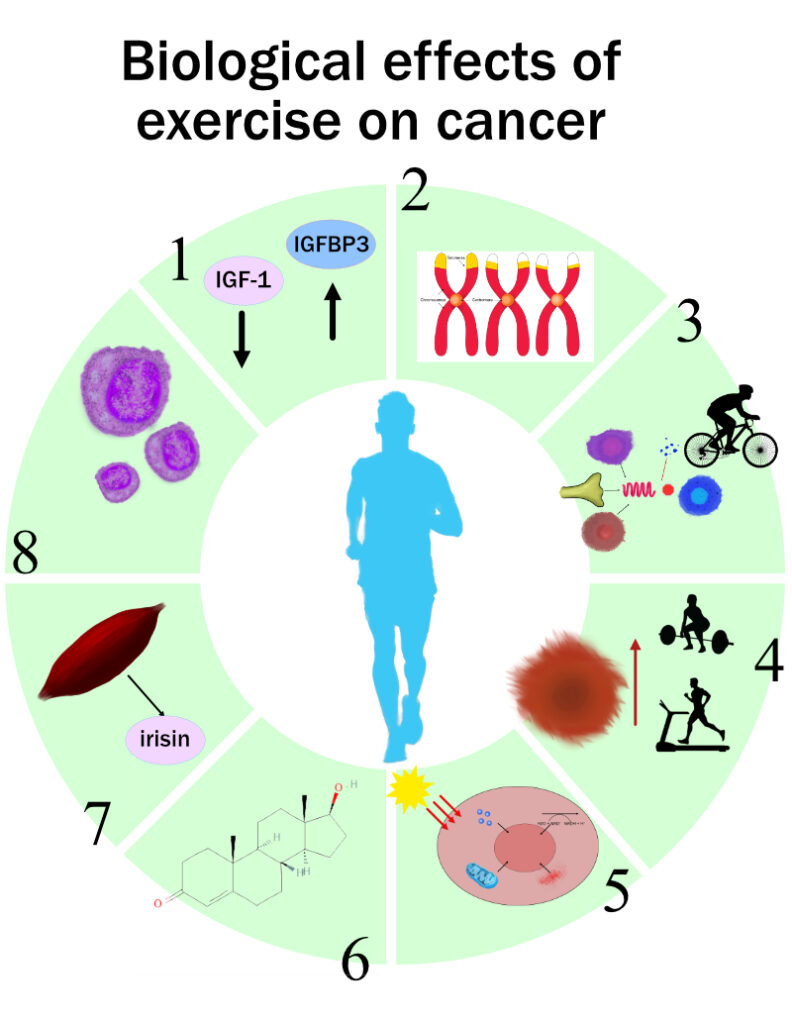
There are several biological mechanisms from exercise that reduce the risks of getting cancer and improve cancer survivors’ quality of life. Published in the British Journal of Sports Medicine, a 2017 review highlighted several direct and indirect effects of exercise on cancer, primarily breast and prostate—based on 168 studies.
The researchers, led by Dr. Robert J. Thomas of the Royal London Hospital for Integrated Medicine, wrote that these mechanisms are “inter-related” and are split into direct and indirect effects.
Direct effects
Insulin-like growth factor (IGF-1): IGF-1 is a hormone that helps cells grow and divide. High levels of IGF-1 can encourage tumor growth and increase the risk of getting cancer. When it binds to a protein called tyrosine kinase that can “turn on or off” various cell functions, IGF-1 activates several signaling pathways that inhibit cell death.
Exercise lowers IGF-1 levels and raises a protein called IGFBP3 that helps control IGF-1. In one example, a 2006 Australian study with more than 41,500 people, those who exercised and had lower IGF-1 levels had a 48% relative risk reduction in cancer mortality (mainly colon) compared to sedentary people.
Epigenetics on DNA repair and telomere length: Like IGF-1, exercise could affect what genes can be “turned on or off” by phenotype expression. In a 2014 study of 71 men with low risk of prostate cancer, 184 genes were found to have different genetic expressions between men who exercised vigorously three or more hours per week versus sedentary men. Genes sensitive to exercise included those involved in DNA repairs and signaling, such as BRCA1 and BRCA. These two proteins act as tumor suppressors to preserve genetic material.

Exercise can also decrease the rate of telomere shortening, which is the natural cycle of the aging process. Telomeres are nucleotides that are on the ends of chromosomes to protect them from transcription errors and deterioration. But each time a cell divides, it loses a little bit of telomeres.
A pilot five-year study in 2013 published in Lancet Oncology found that among men with early stages of prostate cancer, active and healthier men had slightly longer telomeres and reduced prostate cancer progression compared to sedentary men. However, Thomas and his colleagues are uncertain if this change has any meaningful effect on health and aging.
Vasoactive intestinal peptide (VIP): This neuropeptide helps cancer cells survive by protecting cancer cells from dying and weakening the immune system. It does this by turning on signals that help tumors grow, allowing cancer cells to migrate more easily,
However, research in breast and prostate cancer has shown that while VIP levels increase slightly after exercise, the rise triggers a production of anti-VIP antibodies to counter rising VIP levels.
Heat shock proteins (HSP): Cells produce HSPs when they are under stress, such as during an infection, low oxygen, high heat, or chemotherapy. HSPs help protect cells by preventing cell death and allowing them to survive dangerous conditions. For example, they rise sharply after a heart attack and also increase after exercise. This rise is smaller in well-trained athletes and is strongest after intense, short bursts of exercise, especially in people who are not very fit.
Some researchers think that higher HSP levels may explain how exercise protects the heart in animal studies and in women with breast cancer who are physically active during chemotherapy. Exercise may increase HSPs which may also help protect brain cells and reduce memory loss caused by chemotherapy.
However, the researchers of the review wrote there can be a downside. Some cancer cells use HSPs to avoid cell death and keep growing, and many cancers produce large amounts of these proteins. In fact, some cancers depend on HSPs to survive, which is why some scientists are studying them as possible drug targets. It is not clear if exercise raises HSP levels enough to actually help cancer cells.
Reactive oxidative stress (ROS) and antioxidant pathways: ROS are unstable molecules that can damage DNA. However, regular exercise trains the body to make more antioxidant enzymes, which neutralize ROS and protect the cells. And so, eating foods rich in natural antioxidants, like fruits and vegetables, helps this process.

Testosterone: Excessive levels of testosterone can increase the risk of prostate cancer. While there is a temporary spike in testosterone after exercise, regular exercise can keep this hormone level in balance. A 2021 systematic review found that exercise—regardless of intensity, duration, and type—can increase the baseline testosterone levels in both older men and women.
Irisin: Irisin is a protein released by muscles during exercise. In lab studies, it slowed the growth of breast cancer cells and made chemotherapy drugs work better, but this effect doesn’t happen in all cancers, such as thyroid, colon, and esophagus.
Immunity: Moderate-intensity exercise boosts immune cells, such as natural killer (NK) cells and T-cells, which help destroy cancer cells. However, strenuous exercise (e.g. ultramarathons) can temporarily weaken immunity.
Chronic inflammation and prostaglandins: Low-grade, chronic inflammation can increase the risks of cancer, especially among the elderly, obese, type II diabetics, and sedentary, according to the review’s researchers. Because exercise increases the number of white blood cells, this decreases inflammatory markers circulating in the blood.
This reduces the amount of C-reactive protein and prostaglandins, which are pro-inflammatory biomarkers that increase the risk of certain types of cancer. This effect happens even without weight loss. Anti-inflammatory drugs and fresh vegetables lower the amount with moderate exercise.
Energy metabolism and insulin resistance: Exercise lowers blood sugar and insulin levels, making the body more sensitive to insulin. Low insulin sensitivity and high blood sugar levels are tied to higher cancer risk.
Also, Thomas and his colleagues reported exercise improves insulin sensitivity and glucose metabolism in men receiving androgen deprivation therapy (ADT), a prostate cancer treatment that raises the risk of metabolic syndrome, excess body fat, high blood lipids, and muscle loss.
Indirect effects
Thomas and his colleagues wrote that indirect and direct effects can overlap each other.
Weight loss: Fat tissues produce the hormone leptin and the sex hormone estrogens, and so, people with high amounts of body fat have high levels of both. Leptin can directly promote breast cancer and also acts through estrogen and insulin pathways to increase blood vessel growth and cell division, which helps explain why higher leptin levels are linked to breast, prostate, and ovarian cancers., according to the researchers.
While exercise has a moderate effect on decreasing body fat, other physiological effects have a greater effect which do not always require a significant amount of fat loss.
“Exercise and dietary modification help weight control and lower serum triglycerides, total cholesterol, and improve the ratio of high density lipoprotein to low density lipoprotein,” Thomas et al. wrote. “…studies have suggested that high levels of cholesterol in the blood are associated with increased risk of cancer and progression of cancer.”
Vitamin D: People who exercise outdoors tend to have higher vitamin D levels because sunlight triggers vitamin D production in the skin. While too much sun can damage skin and raise the risk of skin cancer, moderate sun exposure helps maintain vitamin D, which may slow cancer growth by affecting how cells grow, mature, and self-destruct.
Thomas et al. wrote higher vitamin D levels are linked to lower death rates from colorectal, breast, and prostate cancer, but taking vitamin D supplements has not clearly been shown to provide the same benefit. Sunlight itself, apart from vitamin D, may also lower prostate cancer risk by affecting the immune system and body rhythms.
Psychological well-being: Some research indicates that those who adopt exercise and a healthier diet have been shown to reduce fear and anxiety of cancer relapse. Thomas et al. wrote that anxiety and depression are linked to shorter survival after major cancer treatments. Large studies have found that men with prostate cancer who were depressed had lower survival rates, and similar results were reported in people with head and neck cancer.
While it’s still unclear exactly how exercise lowers depression and anxiety, Thomas et al. think several factors may be involved, including increased release of endorphins and other “feel-good” brain chemicals that lift mood, improved adherence to medical treatments, and the mental distraction that exercise provides.
This long list is not conclusive and there are more factors that were not covered in this review. “It also remains unclear which of these mechanisms has the most important role, or whether they vary by person or by disease,” Thomas et al. wrote.
“It’s hard to change behaviour, so most doctors give up trying to change people’s habits,” Thomas told Massage & Fitness Magazine in an email interview. He added that “massive lobbying from drug companies” and “short-sighted healthcare providers who are fixed on immediate results” are also part of the problem.
However, some countries are making a push to integrate lifestyle care and education as part of their healthcare system. “Lithuania is pretty motivated. They are developing a post-graduate qualification in lifestyle medicine with a plan to integrate lifestyle medicine into routine clinical practice,” Thomas said.
Part 2 of the exercise and cancer goes beyond biology, starting with psychosocial factors and exercise and cancer treatment accessibility.

Nick Ng, BA
Nick Ng is the editor of Massage & Fitness Jounal and the managing editor for My Neighborhood News Group.
An alumni from San Diego State University with a bachelor’s degree in graphic communications, Nick had also completed his massage therapy training at International Professional School of Bodywork in San Diego in 2014. In 2021, he earned an associate’s degree in journalism at Palomar College.
When he gets a chance, he enjoys weightlifting at the gym, salsa dancing, and exploring new areas in the Puget Sound area in Washington state.